I wanted to weigh in on the 'controversy' momentarily.
1. Bowing is a sign of respect, but in addition it is in many ways the 'Japanese handshake'. To bow to someone isn't to lessen your authority or power. Obama was probably just trying to be polite, and to participate in a Japanese cultural act as a symbol of cultural understanding.
2. While the angle of the bow can indicate subservience or submission, I think the reason Obama bowed as low as he did has more to do with the height difference.
I mean, the emperor is pretty short. Obama is pretty tall. The pictures I've seen of it make Obama look like a giant next to a midget, even though I think the height difference is less pronounced.
It just struck me as such a silly thing to get worked up over.
Thursday, November 19


Thursday, October 29
Kamemushi War!!!! カメムシ戦争
The cooler days are bringing an end to the spider and bee reign of terror on my life, but an unfortunate side effect of the shift in temperature is the rise of that foe unbeatable by conventional warfare, the kamemushi.
While bees and spiders are easily killed without remorse and with little hassle (unless you like to keep the soles of your shoes clean, freak), death is the ultimate weapon of the kamemushi. While living he is menacing, like a suicide bomber but instead of dynamite that produces an explosion, he has glands in his thorax between the first and second pair of legs which produce foul smelling liquid.* He taunts you, daring you to smush him with a rolled up newspaper, slowly crawling around, or falling on the ground legs up and writhing pitifully. Daring you to make your move. Daring you to be your own undoing.
The kamemushi protests he only attacks when he himself is threatened, but there is nothing passive about the full-on assault the kamemushi is waging upon this fair hillside country school. In one classroom yesterday, intrepid students counted 200 of the kamemushi which had invaded.
That's what this is. An invasion.
Kamemushi King, if there is such a thing, I beg of you. Please leave. Take your army and go elsewhere. While you are easy to kill, doing so only harms ourselves in turn... NO, please give us peace. We want peace. Give us your demands.
*Thanks wikipedia!

I found this on google images. Work of a kamemushi sympathizer.
While bees and spiders are easily killed without remorse and with little hassle (unless you like to keep the soles of your shoes clean, freak), death is the ultimate weapon of the kamemushi. While living he is menacing, like a suicide bomber but instead of dynamite that produces an explosion, he has glands in his thorax between the first and second pair of legs which produce foul smelling liquid.* He taunts you, daring you to smush him with a rolled up newspaper, slowly crawling around, or falling on the ground legs up and writhing pitifully. Daring you to make your move. Daring you to be your own undoing.
The kamemushi protests he only attacks when he himself is threatened, but there is nothing passive about the full-on assault the kamemushi is waging upon this fair hillside country school. In one classroom yesterday, intrepid students counted 200 of the kamemushi which had invaded.
That's what this is. An invasion.
Kamemushi King, if there is such a thing, I beg of you. Please leave. Take your army and go elsewhere. While you are easy to kill, doing so only harms ourselves in turn... NO, please give us peace. We want peace. Give us your demands.
*Thanks wikipedia!

I found this on google images. Work of a kamemushi sympathizer.
Tuesday, October 27
NO joke...
How many workers does it take to perform maintenance on a single Japanese pine tree at area Japanese junior high school? (Bonus question: How long do they spend on the tree?)
Answer: 14. 7 to work hands-on, removing and manipulating individual needles. 7 to watch and make sure the other 7 don't muck it up.
Bonus answer: about 1 hour per tree.
Trees look nice though.
Answer: 14. 7 to work hands-on, removing and manipulating individual needles. 7 to watch and make sure the other 7 don't muck it up.
Bonus answer: about 1 hour per tree.
Trees look nice though.
Wednesday, October 14
ノーメーク、ノーライフ No make, no life.
Yesterday during the 3rd year classes, the students were given much of the period to study for their midterms today on their own. In one class, I happened to spend most of the class just chatting with one of the girls Rio, as well as a few other students, but mostly Rio.
The conversation started when I asked Rio if she was going to study. She said no, and then started staring at me. After a few moments...
'Jessie-sensei...no make??' ('no make' is kind of Japanese-English (和製英語) which means 'no make-up')
'Right, I have no make-up on.'
'kirei! Very Beautiful!'
Warm fuzzies. Awww.
The conversation lasted a while, and we discussed all sorts of things, like cooking and eye color and gyaru and the ideal kind of boy.
Rio is good at cooking, and doesn't want a guy who does 'girly things' like cooking. Nearby student Rina would prefer a guy who can cook and clean, because she can't do those things herself. I stated my preference for cooking-enabled men.
The conversation started when I asked Rio if she was going to study. She said no, and then started staring at me. After a few moments...
'Jessie-sensei...no make??' ('no make' is kind of Japanese-English (和製英語) which means 'no make-up')
'Right, I have no make-up on.'
'kirei! Very Beautiful!'
Warm fuzzies. Awww.
The conversation lasted a while, and we discussed all sorts of things, like cooking and eye color and gyaru and the ideal kind of boy.
Rio is good at cooking, and doesn't want a guy who does 'girly things' like cooking. Nearby student Rina would prefer a guy who can cook and clean, because she can't do those things herself. I stated my preference for cooking-enabled men.
Japanese names (Real ones)
This morning it's test day at work, so I have been hunting out interesting reading materials in the meantime.
This trio of articles from The Japan Times cover some of the interesting history of names in Japan.
What's in a (Japanese) name? This article touches on the naming conventions of the pre-modern era as well as the taboo/'neuroses' surrounding personal names in that era.
The long road to identity This article details the origins of some of the most common names in Japan, such as 'Tanaka' (in the rice field). Of the three articles, I recommend this one the most.
Fake names were to the fore in many a rise from humblest to highest This article describes how people in Japan, in particular Toyotomi Hideyoshi, changed their names in a reflection of their rising status.
Tangentially related, I found this editorial by activist and naturalized Amerian-born Japanese citizen Debito Arudou about the case of the international custody dispute between a divorced Japanese woman and American man. The article's brief summary:
But what really shocked me about the article was the fact that in Japan, even for a divorced Japanese couple, there is no way to have joint custody of children. A child can only legally be connected to one family, so when the family splits into two, they are no longer connected to one parent by law... Many children in divorced families lose contact with one parent (usually dad) until adulthood, or forever.
I guess if the father wants to lose all contact with their children, it works out for them. But in cases where the non-custodial parent would want to be a part of their children's lives, there is no legal recourse for them if the custodial parent refuses to capitulate.
This trio of articles from The Japan Times cover some of the interesting history of names in Japan.
What's in a (Japanese) name? This article touches on the naming conventions of the pre-modern era as well as the taboo/'neuroses' surrounding personal names in that era.
The long road to identity This article details the origins of some of the most common names in Japan, such as 'Tanaka' (in the rice field). Of the three articles, I recommend this one the most.
Fake names were to the fore in many a rise from humblest to highest This article describes how people in Japan, in particular Toyotomi Hideyoshi, changed their names in a reflection of their rising status.
Tangentially related, I found this editorial by activist and naturalized Amerian-born Japanese citizen Debito Arudou about the case of the international custody dispute between a divorced Japanese woman and American man. The article's brief summary:
After a couple divorced in America, ex-wife Noriko Savoie absconded with their children to Japan. Then ex-husband Christopher, who had been awarded custody in the U.S., came to Japan to take the kids back. On Sept. 28 he tried to get the children into the American Consulate in Fukuoka, but was barred entry and arrested by the Japanese police for kidnapping.
But what really shocked me about the article was the fact that in Japan, even for a divorced Japanese couple, there is no way to have joint custody of children. A child can only legally be connected to one family, so when the family splits into two, they are no longer connected to one parent by law... Many children in divorced families lose contact with one parent (usually dad) until adulthood, or forever.
I guess if the father wants to lose all contact with their children, it works out for them. But in cases where the non-custodial parent would want to be a part of their children's lives, there is no legal recourse for them if the custodial parent refuses to capitulate.
Thursday, October 8
漢字で名前 Writing your name in Japanese
For official documents and the like, I write my name as ジェシカ パーカー. This comes out in English as something like 'Jeshika Paakaa' with long vowel sounds in the 'parker' bit.
However, most foreign people who come here at some point choose some kanji to represent their name.
Kanji, the complex characters imported long ago from China, are used predominantly for names in Japan. Kanji for names tend to be very complex and can have many readings. For example, the kanji for 'west' 西 can be read nishi, sai, and sei. Anyone who has sent me snail mail before might be interested that the 'Sai' in 'Saihaku' means 'west.' Many kanji have far more readings than this.
Following current naming trends in Japan, one could go the route of ateji and choose kanji based on meaning and arbitrarily assign readings to them. An example here is the word 'Tobacco', which came to Japan many years ago. Tobacco is usually written in hiragana like this: たばこ (tabako). However, in the Meiji era (1868-1912), this was commonly written in kanji as 煙草. If you used the typical readings of these kanji it would come out 'ensou' or 'kemurikusa' or something like that, but these kanji were read as 'tabako' regardless of their true meanings.
However, most parents in Japan still use traditional readings when they choose kanji for names, and most foreigners who choose kanji for their names do the same.
Ideally, one can find kanji for ones name which both have the appropriate sounds as well as a good meaning. For my first name, I need 4 kanji. One to represent 'Ji' 'E' 'Shi' and 'Ka'.
Here are some 'funny' examples I've come up with:
児枝鹿 - Newborn, Branch, Deer
時餌死蚊 - Time, Animal feed, Death, Mosquito
As you can see, choosing based on sound alone could leave one with a ridiculous name.
In English, as per my 'name meaning' mug that currently resides at my parent's house in Florida, my name means 'Grace of God' in Hebrew. Therefore, I wanted to have a name that had the meaning of Grace or something similar in it.
Here are some kanji I like for my name: 慈恵紫花
慈 - Ji - mercy
恵 - E - blessing, grace
紫 - Shi - purple
花 - Ka - flower
I found a keychain with the first character on it. :)
For my last name, I like to use 公園人 (public recreational) park-er or 駐車人 - (car) park-er. The first corresponds to the name's origin in English. The second is for laughs (hur hur, Parker...do you park cars for a living? hurhur.) But both have different readings, kouenjin and chuushajin respectively. Really, they are both for laughs...
What kanji would you choose for your name? If you are interested, let me know in the comments and I will help you pick some out.
However, most foreign people who come here at some point choose some kanji to represent their name.
Kanji, the complex characters imported long ago from China, are used predominantly for names in Japan. Kanji for names tend to be very complex and can have many readings. For example, the kanji for 'west' 西 can be read nishi, sai, and sei. Anyone who has sent me snail mail before might be interested that the 'Sai' in 'Saihaku' means 'west.' Many kanji have far more readings than this.
Following current naming trends in Japan, one could go the route of ateji and choose kanji based on meaning and arbitrarily assign readings to them. An example here is the word 'Tobacco', which came to Japan many years ago. Tobacco is usually written in hiragana like this: たばこ (tabako). However, in the Meiji era (1868-1912), this was commonly written in kanji as 煙草. If you used the typical readings of these kanji it would come out 'ensou' or 'kemurikusa' or something like that, but these kanji were read as 'tabako' regardless of their true meanings.
However, most parents in Japan still use traditional readings when they choose kanji for names, and most foreigners who choose kanji for their names do the same.
Ideally, one can find kanji for ones name which both have the appropriate sounds as well as a good meaning. For my first name, I need 4 kanji. One to represent 'Ji' 'E' 'Shi' and 'Ka'.
Here are some 'funny' examples I've come up with:
児枝鹿 - Newborn, Branch, Deer
時餌死蚊 - Time, Animal feed, Death, Mosquito
As you can see, choosing based on sound alone could leave one with a ridiculous name.
In English, as per my 'name meaning' mug that currently resides at my parent's house in Florida, my name means 'Grace of God' in Hebrew. Therefore, I wanted to have a name that had the meaning of Grace or something similar in it.
Here are some kanji I like for my name: 慈恵紫花
慈 - Ji - mercy
恵 - E - blessing, grace
紫 - Shi - purple
花 - Ka - flower
I found a keychain with the first character on it. :)
For my last name, I like to use 公園人 (public recreational) park-er or 駐車人 - (car) park-er. The first corresponds to the name's origin in English. The second is for laughs (hur hur, Parker...do you park cars for a living? hurhur.) But both have different readings, kouenjin and chuushajin respectively. Really, they are both for laughs...
What kanji would you choose for your name? If you are interested, let me know in the comments and I will help you pick some out.
Wednesday, October 7
Changing directions
Pardon the following boring blog-related post!
I've started to reconsider my blog. A lot of times I don't know what to write because I'm too worried about audience, topic, etc. I leave a lot unwritten because it doesn't necessarily fit with my ideas of what this blog should be.
So, what I am thinking I will be doing in the coming weeks is moving this blog to a new name and expanding it to a general blog that just happens to be authored by me, a person living in Japan. The focus of Japan and Japan-y things will likely continue, considering many of my observations and thoughts have to do with where I am and what I am doing. But you will probably see an increase in 'videos I found on YouTube and want to share' or 'Books I read' or 'Things I'm thinking about'.
I know I could have been doing that all along here, but for some reason I allowed my perception of what this blog had to be prevent me from sharing a lot I may have shared had I not limited myself artificially in this way.
I also hope to up my post count to at least 5-7 posts a week (not necessarily every day, any maybe not only one post per day.)
I've started to reconsider my blog. A lot of times I don't know what to write because I'm too worried about audience, topic, etc. I leave a lot unwritten because it doesn't necessarily fit with my ideas of what this blog should be.
So, what I am thinking I will be doing in the coming weeks is moving this blog to a new name and expanding it to a general blog that just happens to be authored by me, a person living in Japan. The focus of Japan and Japan-y things will likely continue, considering many of my observations and thoughts have to do with where I am and what I am doing. But you will probably see an increase in 'videos I found on YouTube and want to share' or 'Books I read' or 'Things I'm thinking about'.
I know I could have been doing that all along here, but for some reason I allowed my perception of what this blog had to be prevent me from sharing a lot I may have shared had I not limited myself artificially in this way.
I also hope to up my post count to at least 5-7 posts a week (not necessarily every day, any maybe not only one post per day.)
Friday, September 18
School Refusers
There are a number of school refusers in my current school. A school refuser is one who, for whatever reason, refuses to come to school.
We started the school year with 1. Now we have 5.
We did have one boy who refused to come to school during sports festival and associated practices, but is back now.
I wonder if my other school has many now? I remember we had only one as well last time I was there.
We started the school year with 1. Now we have 5.
We did have one boy who refused to come to school during sports festival and associated practices, but is back now.
I wonder if my other school has many now? I remember we had only one as well last time I was there.
Thursday, September 10
I think I'll pass.
Tokyo is known for its ridiculously high rent prices for small spaces.
I found this article about a new retail business, closet-sized ...apartments? crawlspaces? addresses for hire? way to slowly drive oneself mad by depriving oneself of the comforts of life?
"Cheaper than a regular gaijin (foreigner) house and more comfortable than the couch at an Internet cafe, oshiire (closet) houses provide 1 1/2-tatami-mat-size (2.5-sq. meter), often windowless "rooms" — picture a capsule hotel pod as your home."
Click here for the rest of 'Half a room, without a view'
I found this article about a new retail business, closet-sized ...apartments? crawlspaces? addresses for hire? way to slowly drive oneself mad by depriving oneself of the comforts of life?
"Cheaper than a regular gaijin (foreigner) house and more comfortable than the couch at an Internet cafe, oshiire (closet) houses provide 1 1/2-tatami-mat-size (2.5-sq. meter), often windowless "rooms" — picture a capsule hotel pod as your home."
Click here for the rest of 'Half a room, without a view'
Wednesday, September 9
Kyuushoku Best Ten and Worst Ten
In no particular order, things that pop up and make an impression on my palate or senses.
BEST (Lunch makes me happy!)
1. Grilled fish with a miso sauce. Mmm mmm mmm. Minus points if I have to pick through bones though.
2. Curry. Always good, whether they go for a traditional Japanese curry or mix it up with some dry curry or more Indian style.
3. Salads with Sesame (goma) dressing. I have such a love affair going on with Goma Dressing.
4. Niku-jaga and its relatives. Beef stew and it always has the right flavors and I don't have to deal with anything strange popping up.
5. Anything that claims to be sushi. This includes Temakizushi (you are given the rice, the seaweed, and the fillings, and you do a 'make your own' sushi wrap) or Chirashizushi (stuff thrown on top of sushi rice) I like the way the rice tastes, and the toppings/fillings are usually good. One time the rice was just normal rice though. Other teachers complained loudly, voicing my thoughts for me.
6. Spinach salads. Mom must have done something to me when I was young because I love the taste of spinach. (Also love - mustard greens (小松菜), garlic chives (ニラ), and Mizuna)
7. Fried (anything). Notably delicious are Shrimp and Pumpkin Croquettes.
8. Fruit, when easy to eat. I also tolerate fresh oranges even though they make my hands all sticky.
9. Tofu anything. Especially in a nicely flavored soup with greens and pork.
10. Desert! Today we had Sudachi (kinda like a lime) flavored Jello.
WORST (Lunch makes me CRY)
1. Noodle dishes. The noodles are invariable overdone and mushy. We did have a semi-decent spaghetti once though.
2. Whole Fishes, ESPECIALLY Shishamo (AKA tiny river fish ready to lay some eggs in your stomach). Even if I am not expected to consume it whole, the process of working around the fish bones with my chopsticks is time consuming and annoying.
3. Natto. Mother of all painful lunches. Worst when someone decided it went ok with mayonnaise. I can handle it though...somehow.
4. Bread. The exception is Pineapple Bread, which has enough moisture from the pineapple to be quite tasty, but usually the bread I get is dry and unappetizing.
5. Rubbery, what are they smoking today? salads. Usually tasteless and boring. Eaten quickly so as to use the better parts of the meal to help one forget about their depressing existence. Honorable mention - that potato salad with apples in it.
6. Tasteless Soup. Please add seasoning.
7. Getting the mushy part of the rice. It's like ...eating mushy rice.
8. Most squid. I only like squid two ways -- dried or fried. Keep your grilled, boiled, whatevered squid out of my life.
9. Salt Salmon. Hey what does salmon taste like if you grill it with a ton of salt until it's the consistency of canned salmon? ...mostly just like salt.
10. Frozen Mandarin Oranges. A crime against nature.
Some things I hated a year ago are gone from the 'worst' list. Prime example is 'purple rice'...I've grown to like the taste of the pickled purple...things which give it its flavor. Hooray for assimilation!
BEST (Lunch makes me happy!)
1. Grilled fish with a miso sauce. Mmm mmm mmm. Minus points if I have to pick through bones though.
2. Curry. Always good, whether they go for a traditional Japanese curry or mix it up with some dry curry or more Indian style.
3. Salads with Sesame (goma) dressing. I have such a love affair going on with Goma Dressing.
4. Niku-jaga and its relatives. Beef stew and it always has the right flavors and I don't have to deal with anything strange popping up.
5. Anything that claims to be sushi. This includes Temakizushi (you are given the rice, the seaweed, and the fillings, and you do a 'make your own' sushi wrap) or Chirashizushi (stuff thrown on top of sushi rice) I like the way the rice tastes, and the toppings/fillings are usually good. One time the rice was just normal rice though. Other teachers complained loudly, voicing my thoughts for me.
6. Spinach salads. Mom must have done something to me when I was young because I love the taste of spinach. (Also love - mustard greens (小松菜), garlic chives (ニラ), and Mizuna)
7. Fried (anything). Notably delicious are Shrimp and Pumpkin Croquettes.
8. Fruit, when easy to eat. I also tolerate fresh oranges even though they make my hands all sticky.
9. Tofu anything. Especially in a nicely flavored soup with greens and pork.
10. Desert! Today we had Sudachi (kinda like a lime) flavored Jello.
WORST (Lunch makes me CRY)
1. Noodle dishes. The noodles are invariable overdone and mushy. We did have a semi-decent spaghetti once though.
2. Whole Fishes, ESPECIALLY Shishamo (AKA tiny river fish ready to lay some eggs in your stomach). Even if I am not expected to consume it whole, the process of working around the fish bones with my chopsticks is time consuming and annoying.
3. Natto. Mother of all painful lunches. Worst when someone decided it went ok with mayonnaise. I can handle it though...somehow.
4. Bread. The exception is Pineapple Bread, which has enough moisture from the pineapple to be quite tasty, but usually the bread I get is dry and unappetizing.
5. Rubbery, what are they smoking today? salads. Usually tasteless and boring. Eaten quickly so as to use the better parts of the meal to help one forget about their depressing existence. Honorable mention - that potato salad with apples in it.
6. Tasteless Soup. Please add seasoning.
7. Getting the mushy part of the rice. It's like ...eating mushy rice.
8. Most squid. I only like squid two ways -- dried or fried. Keep your grilled, boiled, whatevered squid out of my life.
9. Salt Salmon. Hey what does salmon taste like if you grill it with a ton of salt until it's the consistency of canned salmon? ...mostly just like salt.
10. Frozen Mandarin Oranges. A crime against nature.
Some things I hated a year ago are gone from the 'worst' list. Prime example is 'purple rice'...I've grown to like the taste of the pickled purple...things which give it its flavor. Hooray for assimilation!
Tuesday, September 8
Tuesday, September 1
空気を読めるように Learning to 'read the air'
I was reading this column, Cultural Conundrums: Can you guess when to guess?, and it made me think of an incident that happened, oh, yesterday.
The column covers the idea of omoiyari, something akin to empathy, which in Japan means you guess or assert knowledge over what another person is thinking, and act according to that assumption. The column further states that this is seen in Japan as 'good' but in the US and many other places would be considered 'arrogant.'
Last week, the school nurse passed out some papers for ordering lunch for the coming sports day this Saturday. She also had some pictures of the food that was being offered. I looked at all of this, decided it was not for me. She brought it up briefly every morning in the meeting, I listened quietly and reaffirmed internally that I would bring my own lunch and save money and eat healthier.
Fast-forward to Monday. I had elementary classes all day, but stopped by the junior high to print something out from my computer for my teacher. As I was leaving, I saw the school nurse in the hall. She greeted me, and I greeted her back. Then she brought up the lunch thing. Uh-oh. I actually had this happen last year at my other school's sports day (in which I was subjected to the eating of two cold hamburgers with cheese on them) and could tell I had made an error this year as well. She told me that since I hadn't ordered anything, and she was worried I wouldn't have any food, she had ordered me a hamburger.
Augh! Frustration hit me (self-directed, at my failure to behave appropriately to avoid this misunderstanding), since the last thing I wanted was another cold hamburger. I quickly stated that I had planned to bring my own lunch, but if there was nothing that could be done about it... The nurse cut me short, praising my ability to prepare my own lunch and apologizing for ordering something for me, and then telling me not to worry about it and to bring my own lunch as I had planned.
All this said, it's just one of those situations where yet again false assumptions were made about me. I suppose sometimes I feel integrated to the point where I expect to be treated like those around me, but people ascribe much different thinking to me on account of my otherness, or their perceived barriers to communication with me. Now, honestly, I like the school nurse. And given this article, I think she only responded how culture conditioned her to. Additionally, if I had stated to her that I planned to bring my own lunch, instead of merely tossing out my order form without comment, she would have been spared the situation of making an incorrect judgement call.
I'd like to think both of us learned something from this exchange however. She may have learned to reevaluate her assumptions of foreigners in general and me in particular, and I remembered that I need to be sensitive to the cultural norms which differ in the US and Japan and respond accordingly.
The column covers the idea of omoiyari, something akin to empathy, which in Japan means you guess or assert knowledge over what another person is thinking, and act according to that assumption. The column further states that this is seen in Japan as 'good' but in the US and many other places would be considered 'arrogant.'
Last week, the school nurse passed out some papers for ordering lunch for the coming sports day this Saturday. She also had some pictures of the food that was being offered. I looked at all of this, decided it was not for me. She brought it up briefly every morning in the meeting, I listened quietly and reaffirmed internally that I would bring my own lunch and save money and eat healthier.
Fast-forward to Monday. I had elementary classes all day, but stopped by the junior high to print something out from my computer for my teacher. As I was leaving, I saw the school nurse in the hall. She greeted me, and I greeted her back. Then she brought up the lunch thing. Uh-oh. I actually had this happen last year at my other school's sports day (in which I was subjected to the eating of two cold hamburgers with cheese on them) and could tell I had made an error this year as well. She told me that since I hadn't ordered anything, and she was worried I wouldn't have any food, she had ordered me a hamburger.
Augh! Frustration hit me (self-directed, at my failure to behave appropriately to avoid this misunderstanding), since the last thing I wanted was another cold hamburger. I quickly stated that I had planned to bring my own lunch, but if there was nothing that could be done about it... The nurse cut me short, praising my ability to prepare my own lunch and apologizing for ordering something for me, and then telling me not to worry about it and to bring my own lunch as I had planned.
All this said, it's just one of those situations where yet again false assumptions were made about me. I suppose sometimes I feel integrated to the point where I expect to be treated like those around me, but people ascribe much different thinking to me on account of my otherness, or their perceived barriers to communication with me. Now, honestly, I like the school nurse. And given this article, I think she only responded how culture conditioned her to. Additionally, if I had stated to her that I planned to bring my own lunch, instead of merely tossing out my order form without comment, she would have been spared the situation of making an incorrect judgement call.
I'd like to think both of us learned something from this exchange however. She may have learned to reevaluate her assumptions of foreigners in general and me in particular, and I remembered that I need to be sensitive to the cultural norms which differ in the US and Japan and respond accordingly.
Thursday, August 27
Bowing
This is almost another edition of 'You know you've been in Japan too long when...' but today I tackle the complex question of bowing.
Most westerners know that bowing is something like the 'Japanese handshake'
Well, that is true, although the ACTUAL handshake is increasingly used in typical handshake situations, in keeping with the westernization of Japan. However, bowing has a broader scope than 'How Do You Do?', being employed for various situations not limited to introductions.
We had our opening ceremony for the second school semester yesterday (...there's one for each of the three semesters, as well as closing ceremonies, as well as a graduation ceremony in March and an entrance ceremony for new students in April which PRECEDES the opening ceremony, later in April...), and as usual there were a number of bows.
Kore de nigakki no shigyoushiki wo hajimemasu! Ichido, rei! is how these things start out. To translate, 'Henceforth we begin the opening ceremony. Bow once!' ...everyone bows! Yay! There are about 8-10 bows during this ceremony, including bows to any speaker before and after their speech, and a closing bow.
If you want to imagine a graduation ceremony, take this and multiply it by 60.
Another situation I bow in everyday, although it is somewhat similar to the previous, is Morning Meeting. In the morning at 8:30, the bell goes off and everyone rises to their feet. The leader for the day starts us off and says Ohayo gozaimasu! (Good morning!) and we all in unison say, Ohayo gozaimasu with a bow and then sit back down. It's kind of funny because most people are sitting back down mid-bow, and rarely do people actually stand all the way back up before sitting down. Same at the end, but the greeting is changed to Kyou mo ganbarimasho! (Today also we will do our best), with the response of Ganbarimasho!
Another thing about bows is you almost always return them. One case I can think of where people tend not to though is the service industry. The cashier, the receptionist, the fast food employee, all will do a perfunctory bow after they hand you your change or answer your questions or finish your order. There is also an epidemic of 'phone bowing', similar to the 'phone nod' wherein one bows on the telephone because in a normal situation one would be bowing, but since it is on the telephone it is meaningless except as an indicator of how ingrained ones bow reflex is in.
And I have definitely picked up the reflex. This morning, an old man pulled to the size of the 1-car-sized road that leads to my house to allow me to pass by him. I bowed as I passed by, he bowed back. Common courtesy.
Most westerners know that bowing is something like the 'Japanese handshake'
Well, that is true, although the ACTUAL handshake is increasingly used in typical handshake situations, in keeping with the westernization of Japan. However, bowing has a broader scope than 'How Do You Do?', being employed for various situations not limited to introductions.
We had our opening ceremony for the second school semester yesterday (...there's one for each of the three semesters, as well as closing ceremonies, as well as a graduation ceremony in March and an entrance ceremony for new students in April which PRECEDES the opening ceremony, later in April...), and as usual there were a number of bows.
Kore de nigakki no shigyoushiki wo hajimemasu! Ichido, rei! is how these things start out. To translate, 'Henceforth we begin the opening ceremony. Bow once!' ...everyone bows! Yay! There are about 8-10 bows during this ceremony, including bows to any speaker before and after their speech, and a closing bow.
If you want to imagine a graduation ceremony, take this and multiply it by 60.
Another situation I bow in everyday, although it is somewhat similar to the previous, is Morning Meeting. In the morning at 8:30, the bell goes off and everyone rises to their feet. The leader for the day starts us off and says Ohayo gozaimasu! (Good morning!) and we all in unison say, Ohayo gozaimasu with a bow and then sit back down. It's kind of funny because most people are sitting back down mid-bow, and rarely do people actually stand all the way back up before sitting down. Same at the end, but the greeting is changed to Kyou mo ganbarimasho! (Today also we will do our best), with the response of Ganbarimasho!
Another thing about bows is you almost always return them. One case I can think of where people tend not to though is the service industry. The cashier, the receptionist, the fast food employee, all will do a perfunctory bow after they hand you your change or answer your questions or finish your order. There is also an epidemic of 'phone bowing', similar to the 'phone nod' wherein one bows on the telephone because in a normal situation one would be bowing, but since it is on the telephone it is meaningless except as an indicator of how ingrained ones bow reflex is in.
And I have definitely picked up the reflex. This morning, an old man pulled to the size of the 1-car-sized road that leads to my house to allow me to pass by him. I bowed as I passed by, he bowed back. Common courtesy.
Tuesday, August 25
Jiminto wins the Youtube battle.
As a followup to my last blog entry, here are some videos from Youtube. (Apologies in advance for clunky translation, I tried to keep the spirit of the language and be accurate. Accuracy is another thing I may have failed at.)
Both the LDP (Jiminto) and the DPJ (Minshuto) have Youtube presences, but the LDP rules the day when it comes to style. If you forgive their cheesy logo.

Drawn by a four year old! (probably)
But I question the logic of the commercials, which prominently feature current PM Aso glaring at us. I suppose his glare conveys his sense of responsibility and ability to protect us from terrorists.
Narrator: Who can really protect your life and this country's future? Jiminto.
Highlights - Lion King worthy soundtrack, Taro Aso glaring into my soul.
This is another Jiminto add
Woman: Oh! It's you.
Man: Welcome, it's been a while. It's not just lip service, we're now making policies like this.
Woman: All right then, why don't you show me?
Man: This store's 'Manifesto-men', our best Ramen. We'll win or lose based on it.
Customer 1(American): There's not enough oil!
Man: Ok, we'll supply more.
Customer 2(Resembles Shakaito president Fukushima): Wait, weren't you going to stop supplying oil?
Man: Ending supply.
Customer 3: There's not enough local ingredients...
Man: That's silly. Look, here's some more.
Customer 4: There's no growth here, is there?
Man: Nonono, Look, here's some.
Child: Treat children well too!
Man: Yes, yes, yes. I'm sprinkling on 26,000 yen's worth of furikake!
Woman: Isn't this totally different than what you made in the beginning?
Man: No,no. It was this from the beginning.
Woman: Huh?
'Just by trying to please everyone, you can't make everyone happy. Unwavering policies, Jiminto'
This commercial is on the offensive, with the man running the ramen shop bearing a resemblance to DPJ party president Hatoyama. It paints the DPJ as a bunch of 'flip-floppers' who will give everyone a handout or lip service and have no principles.
Checking in over at DPJ headquarters, the youtube action is much more subdued. The LDP channel had tons of snappy, quick commercials, but the DPJ's channel is more focused on (long, boring) speeches by DPJ politicians. I do give them props for their main video, which features subtitling and sign-language so anyone can follow along with what is being said. Also, Hatoyama comes across as a good public speaker and he never glared at me.
There were only a few actual commercials I could find, all very similar in style. Here is one:
Narrator: You're feeling anxious about the problems of healthcare and pension. For the sake of your way of life, the government must change.
Hatoyama: First, change political power!
Narrator: We are the DPJ.
However, lest you think that the LDPs style wins them the substance war, you have to remember that the LDP has been in power almost continuously since the end of WW2 and therefore are held accountable for wasteful government spending, pension and healthcare issues, and the myriad other things that the DPJ is calling them out on constantly with the battle cry of Seiken Koutai!
The election takes place on August 30th.
Both the LDP (Jiminto) and the DPJ (Minshuto) have Youtube presences, but the LDP rules the day when it comes to style. If you forgive their cheesy logo.

Drawn by a four year old! (probably)
But I question the logic of the commercials, which prominently feature current PM Aso glaring at us. I suppose his glare conveys his sense of responsibility and ability to protect us from terrorists.
Narrator: Who can really protect your life and this country's future? Jiminto.
Highlights - Lion King worthy soundtrack, Taro Aso glaring into my soul.
This is another Jiminto add
Woman: Oh! It's you.
Man: Welcome, it's been a while. It's not just lip service, we're now making policies like this.
Woman: All right then, why don't you show me?
Man: This store's 'Manifesto-men', our best Ramen. We'll win or lose based on it.
Customer 1(American): There's not enough oil!
Man: Ok, we'll supply more.
Customer 2(Resembles Shakaito president Fukushima): Wait, weren't you going to stop supplying oil?
Man: Ending supply.
Customer 3: There's not enough local ingredients...
Man: That's silly. Look, here's some more.
Customer 4: There's no growth here, is there?
Man: Nonono, Look, here's some.
Child: Treat children well too!
Man: Yes, yes, yes. I'm sprinkling on 26,000 yen's worth of furikake!
Woman: Isn't this totally different than what you made in the beginning?
Man: No,no. It was this from the beginning.
Woman: Huh?
'Just by trying to please everyone, you can't make everyone happy. Unwavering policies, Jiminto'
This commercial is on the offensive, with the man running the ramen shop bearing a resemblance to DPJ party president Hatoyama. It paints the DPJ as a bunch of 'flip-floppers' who will give everyone a handout or lip service and have no principles.
Checking in over at DPJ headquarters, the youtube action is much more subdued. The LDP channel had tons of snappy, quick commercials, but the DPJ's channel is more focused on (long, boring) speeches by DPJ politicians. I do give them props for their main video, which features subtitling and sign-language so anyone can follow along with what is being said. Also, Hatoyama comes across as a good public speaker and he never glared at me.
There were only a few actual commercials I could find, all very similar in style. Here is one:
Narrator: You're feeling anxious about the problems of healthcare and pension. For the sake of your way of life, the government must change.
Hatoyama: First, change political power!
Narrator: We are the DPJ.
However, lest you think that the LDPs style wins them the substance war, you have to remember that the LDP has been in power almost continuously since the end of WW2 and therefore are held accountable for wasteful government spending, pension and healthcare issues, and the myriad other things that the DPJ is calling them out on constantly with the battle cry of Seiken Koutai!
The election takes place on August 30th.
Friday, August 21
There's Politics in the air..
Here in Japan, terminally unpopular Prime Minister Taro Aso called an election for August 30th last month. Japan's system is greatly different from the US, with elections being called only a month in advance and campaigning done in large part by people shouting from speakers mounted on the top of cars.
Japan's Political Parties:
Jiminto, full name Jiyu-Minshuto, usually translated into English as the 'Liberal Democratic Party' or the 'LDP' has dominated Japanese politics for basically the entire post-war era. However, the LDP has run into problems in recent years. Following the retirement of Junichiro Koizumi, the popular and stylin' Prime Minister from 2001-2006, the LDP has been led by three different men with abysmal approval ratings: Shinzo Abe, Yasuo Fukuda, and Taro Aso. While not controlling a majority of seats on their own, the LDP controls the Japanese Diet through a coalition government with the New Komeito party. Not one to go quietly into the night, the party is waging an aggressive campaign and standing behind its leader Taro Aso. It is the 'center-right' party and is running on a platform of Nihon o mamoru, sekininryoku, which roughly translates as 'Protecting Japan, the power of responsibility.'
They are expected to lose big-time...
Minshuto, translated into English as the Democratic Party of Japan or DPJ, is currently the second-largest party and led by Yukio Hatoyama (according the Wikipedia, a Baptist??). It is a relatively new party, established in 1999 as a a combination of several smaller parties. The DPJ is expected to win the election on August 30th. Their slogan Seiken Koutai, 'Change political power', is straightforward and clearly appeals to Japan's frustration with the ineffective Jiminto of the last few years. However, the DPJ has its own problems, such as a lack of unity and a number of publicly popular but possibly wrong-headed policy proposals, such as dropping the tolls on Japanese highways (clear why this is popular, but without concurrent cuts in spending this would increase Japan's already ridiculous public debt.) They are considered a 'centrist' party.
Komeito, known in English as the New Komeito Party to distinguish it from one of its fore running parties, is currently the third largest party and forms the majority coalition with the LDP. The party was founded by members of the Buddhist sect/cult Soka Gakkai
Shakai-Minshuto, the Social Democratic Party of Japan, used to be the major opposition party in Japan but is a very small and uninfluential party at present. They currently are members of the minority coalition with the DPJ, and are ideologically center-left.
Kokumin Shinto, the People's New Party, is a party formed very recently in 2005 by members of the LDP who objected to former Prime Minister Koizumi's politics. It is one of the more right-leaning political parties, but is currently a member of the DPJ's coalition, for whatever reason.
Nihon Kyosan-to, the Japanese Communist Party, is a Leninist party, but advocates turning Japan into a communist state through Democratic power rather than revolution. The party is extremely active, especially in Nambu-cho, where I see their signs scattered around all over town. Ima koso, Nihon Kyosan-to!, 'Especially now, Japanese Communist Party!' They don't belong to either the minority or majority coalitions.
I hope you enjoyed your primer on Japanese Political Parties. I'll try to update with more interesting stuff as I find it on the elections.
Japan's Political Parties:
Jiminto, full name Jiyu-Minshuto, usually translated into English as the 'Liberal Democratic Party' or the 'LDP' has dominated Japanese politics for basically the entire post-war era. However, the LDP has run into problems in recent years. Following the retirement of Junichiro Koizumi, the popular and stylin' Prime Minister from 2001-2006, the LDP has been led by three different men with abysmal approval ratings: Shinzo Abe, Yasuo Fukuda, and Taro Aso. While not controlling a majority of seats on their own, the LDP controls the Japanese Diet through a coalition government with the New Komeito party. Not one to go quietly into the night, the party is waging an aggressive campaign and standing behind its leader Taro Aso. It is the 'center-right' party and is running on a platform of Nihon o mamoru, sekininryoku, which roughly translates as 'Protecting Japan, the power of responsibility.'
They are expected to lose big-time...
Minshuto, translated into English as the Democratic Party of Japan or DPJ, is currently the second-largest party and led by Yukio Hatoyama (according the Wikipedia, a Baptist??). It is a relatively new party, established in 1999 as a a combination of several smaller parties. The DPJ is expected to win the election on August 30th. Their slogan Seiken Koutai, 'Change political power', is straightforward and clearly appeals to Japan's frustration with the ineffective Jiminto of the last few years. However, the DPJ has its own problems, such as a lack of unity and a number of publicly popular but possibly wrong-headed policy proposals, such as dropping the tolls on Japanese highways (clear why this is popular, but without concurrent cuts in spending this would increase Japan's already ridiculous public debt.) They are considered a 'centrist' party.
Komeito, known in English as the New Komeito Party to distinguish it from one of its fore running parties, is currently the third largest party and forms the majority coalition with the LDP. The party was founded by members of the Buddhist sect/cult Soka Gakkai
Shakai-Minshuto, the Social Democratic Party of Japan, used to be the major opposition party in Japan but is a very small and uninfluential party at present. They currently are members of the minority coalition with the DPJ, and are ideologically center-left.
Kokumin Shinto, the People's New Party, is a party formed very recently in 2005 by members of the LDP who objected to former Prime Minister Koizumi's politics. It is one of the more right-leaning political parties, but is currently a member of the DPJ's coalition, for whatever reason.
Nihon Kyosan-to, the Japanese Communist Party, is a Leninist party, but advocates turning Japan into a communist state through Democratic power rather than revolution. The party is extremely active, especially in Nambu-cho, where I see their signs scattered around all over town. Ima koso, Nihon Kyosan-to!, 'Especially now, Japanese Communist Party!' They don't belong to either the minority or majority coalitions.
I hope you enjoyed your primer on Japanese Political Parties. I'll try to update with more interesting stuff as I find it on the elections.
Tuesday, July 14
You know you've been in Japan too long when...
You know you've been in Japan too long when...
...a teacher remarks to the students that 'You should have no problem finishing your rice today, because there's seaweed! So eat up!' and you not only find absolutely nothing strange with this comment, you agree with it.
...you keep your AC on 28, and it feels cool to you because you spend the entire day in an office with an average temperature of 30 with only your handheld fan to keep you company.
...you really really want to eat cold noodles for dinner. Zaru Soba YUM.
...a teacher remarks to the students that 'You should have no problem finishing your rice today, because there's seaweed! So eat up!' and you not only find absolutely nothing strange with this comment, you agree with it.
...you keep your AC on 28, and it feels cool to you because you spend the entire day in an office with an average temperature of 30 with only your handheld fan to keep you company.
...you really really want to eat cold noodles for dinner. Zaru Soba YUM.
Wednesday, July 8
How I passed my Japanese driving test on the first try...
Yesterday I drove to the not-so-near town of Yurihama (about 1.5 hours by car) for the second time to continue my license-getting process.
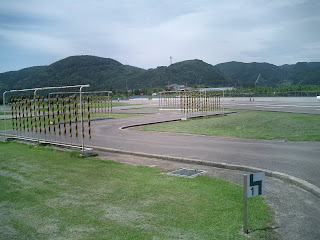
The Crank.
I have until now been driving under the auspices of an international driving permit, which was acquired through my neighborhood AAA and valid for one year. OH LOOK, I've been in Japan for over 11 months. In reality, I should have taken care of all this license mess weeks, nay months, ago. But in the end I was doing it the way I do everything, close to the deadline with moments to spare.
Changing an American drivers license (or a South African one, or a few other countries) to a Japanese license is for many a lengthy and painful process, but easier than getting a Japanese license from scratch. First, you have to get JAF (the Japanese equivalent of AAA) to translate your license from English to Japanese. Then, you have to make an appointment at the prefectural (state) driver's license center. Then, you go in (1.5 hours each way), and give them your paperwork (including the translation, your American license, etc) and have a short interview (in my case, they spent about 15 minutes asking me about my driving history in Japanese).
Then you wait for 1-2 weeks while they check through your paperwork. Then they call you and set up an appointment for you to come in and do your test. Your first test.
My appointment was yesterday. I waffled between confidence and panic. Would my preternatural ability to pass stupid tests come through, or fail me? I read through some materials provided by our prefectural advisor and hoped for the best. On the way to the driving center (1.5 hours drive), I practiced the skills that I knew would be tested.
Turn while braking and don't accelerate through the turn.
Check every mirror and your blind spots before completing a turn.
Drive very close to the left side of the road.
Stop fully and completely behind the stop line.
Once I got to the testing center (1 hour early), I again read through my materials in between reading google news and facebook on my phone. Once it was time for my appointment, I went through the paces. First, fill out an application (and shock my application advisor with my ability to write Japanese). Then, eye test. Then, written test. Then, watching a video about the practical driving test. Finally, the moment of truth, the driving test.
I watched the video really carefully, mimicking and practicing with thin air what the people in the video were doing. But I was still extremely nervous. My application advisor and a test administrator came out with me to the old taxi that would be my testing vehicle. I was still very nervous. I was then told to check out the car and familiarize myself with it, then we would have a 'practice', then the real test would begin. I sat down and adjusted the seat and took stock of where all the controls were. The test would begin when I got into the car, and finish when I exited the car and closed the door.
I got back out of the car, and my advisor got in the back seat while the test administrator was in the passenger seat. I followed the steps prescribed in the materials and the video. Look around the car to make sure there are no obstacles. Open the door, sit down, close the door, and lock it. I went for my seatbelt but remembered that comes later. Check the seat position, and the mirrors, adjust accordingly. Seatbelt. Check to see if the parking break is engaged. Press down on the brake. Check the gear (park, good.). Turn on the engine. Put the car in drive. Check in all directions to make sure it's clear. Drive forward.
OH WAIT. The parking brake is still engaged. At this point I'm sure I've failed. But I mutter a quick 'Sumimasen' (I'm sorry) and continue, this time with the brake disengaged.
Now is our 'training time'. The test admin tells me to make a circle. I do so, and worry the whole time I am doing it wrong. I check the mirrors constantly since the course is so small I'm basically turning constantly. My signal won't stay engaged because I'm turning so much. I hold it down and hope for the best. We make the round and he tells me to pull out onto the 'road' part of the course, and that my test will begin now. I'm ridiculously nervous and pull into the wrong side of the road. He corrects me, I apologize and fix myself. Then he says 'Your test begins now.' No harm no foul perhaps? But I still think I've already failed.
From here on it's a blur. I'm turning a lot. The only thing I am vividly aware of is my head checking my mirrors and blind spots at least once every 10 seconds. I fail to get to 50 km/h on the straightaway as prescribed in the pre-test prep, but I do manage 40... When I pull into the narrow 's-curve' and 'crank' portions of the test, I'm almost happy because they seem way easier than trying to turn at the test admin's every whim. I keep up the best I can but I'm STILL sure I am screwing up royally. I feel peace with this and hope that my post-test critique will give me information I can use to pass next time.
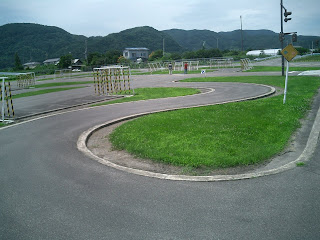
The S-curve.
We make the rounds for what feels like an eternity and no time at all, and return to the starting point. I complete the final steps. Brake. Engage parking brake. Turn off engine. Unbuckle seatbelt. Check out the window to make sure no one will be hit when I open the door. Open the door, step out, close the door.
Test administrator gets out of the car and says 'ok!'
I don't understand that this means I've passed until my advisor gets out and says 'ok! Passed! You pass!'. huh? I passed? Are you serious?
On the walk back to the center, I get asked where I went to driving school. I get asked who helped me pass the test. It's all very amusing to me and I say some stuff about 'friends' helping me out. I had no formal training! I get no critique whatsoever...despite the errors I am sure I made.
Oh well! No use in complaining. I've won! I beat the test! I wait, get my picture snapped, get my license, and head on my merry way home. Success!
And I can still barely believe it.

The Crank.
I have until now been driving under the auspices of an international driving permit, which was acquired through my neighborhood AAA and valid for one year. OH LOOK, I've been in Japan for over 11 months. In reality, I should have taken care of all this license mess weeks, nay months, ago. But in the end I was doing it the way I do everything, close to the deadline with moments to spare.
Changing an American drivers license (or a South African one, or a few other countries) to a Japanese license is for many a lengthy and painful process, but easier than getting a Japanese license from scratch. First, you have to get JAF (the Japanese equivalent of AAA) to translate your license from English to Japanese. Then, you have to make an appointment at the prefectural (state) driver's license center. Then, you go in (1.5 hours each way), and give them your paperwork (including the translation, your American license, etc) and have a short interview (in my case, they spent about 15 minutes asking me about my driving history in Japanese).
Then you wait for 1-2 weeks while they check through your paperwork. Then they call you and set up an appointment for you to come in and do your test. Your first test.
My appointment was yesterday. I waffled between confidence and panic. Would my preternatural ability to pass stupid tests come through, or fail me? I read through some materials provided by our prefectural advisor and hoped for the best. On the way to the driving center (1.5 hours drive), I practiced the skills that I knew would be tested.
Turn while braking and don't accelerate through the turn.
Check every mirror and your blind spots before completing a turn.
Drive very close to the left side of the road.
Stop fully and completely behind the stop line.
Once I got to the testing center (1 hour early), I again read through my materials in between reading google news and facebook on my phone. Once it was time for my appointment, I went through the paces. First, fill out an application (and shock my application advisor with my ability to write Japanese). Then, eye test. Then, written test. Then, watching a video about the practical driving test. Finally, the moment of truth, the driving test.
I watched the video really carefully, mimicking and practicing with thin air what the people in the video were doing. But I was still extremely nervous. My application advisor and a test administrator came out with me to the old taxi that would be my testing vehicle. I was still very nervous. I was then told to check out the car and familiarize myself with it, then we would have a 'practice', then the real test would begin. I sat down and adjusted the seat and took stock of where all the controls were. The test would begin when I got into the car, and finish when I exited the car and closed the door.
I got back out of the car, and my advisor got in the back seat while the test administrator was in the passenger seat. I followed the steps prescribed in the materials and the video. Look around the car to make sure there are no obstacles. Open the door, sit down, close the door, and lock it. I went for my seatbelt but remembered that comes later. Check the seat position, and the mirrors, adjust accordingly. Seatbelt. Check to see if the parking break is engaged. Press down on the brake. Check the gear (park, good.). Turn on the engine. Put the car in drive. Check in all directions to make sure it's clear. Drive forward.
OH WAIT. The parking brake is still engaged. At this point I'm sure I've failed. But I mutter a quick 'Sumimasen' (I'm sorry) and continue, this time with the brake disengaged.
Now is our 'training time'. The test admin tells me to make a circle. I do so, and worry the whole time I am doing it wrong. I check the mirrors constantly since the course is so small I'm basically turning constantly. My signal won't stay engaged because I'm turning so much. I hold it down and hope for the best. We make the round and he tells me to pull out onto the 'road' part of the course, and that my test will begin now. I'm ridiculously nervous and pull into the wrong side of the road. He corrects me, I apologize and fix myself. Then he says 'Your test begins now.' No harm no foul perhaps? But I still think I've already failed.
From here on it's a blur. I'm turning a lot. The only thing I am vividly aware of is my head checking my mirrors and blind spots at least once every 10 seconds. I fail to get to 50 km/h on the straightaway as prescribed in the pre-test prep, but I do manage 40... When I pull into the narrow 's-curve' and 'crank' portions of the test, I'm almost happy because they seem way easier than trying to turn at the test admin's every whim. I keep up the best I can but I'm STILL sure I am screwing up royally. I feel peace with this and hope that my post-test critique will give me information I can use to pass next time.

The S-curve.
We make the rounds for what feels like an eternity and no time at all, and return to the starting point. I complete the final steps. Brake. Engage parking brake. Turn off engine. Unbuckle seatbelt. Check out the window to make sure no one will be hit when I open the door. Open the door, step out, close the door.
Test administrator gets out of the car and says 'ok!'
I don't understand that this means I've passed until my advisor gets out and says 'ok! Passed! You pass!'. huh? I passed? Are you serious?
On the walk back to the center, I get asked where I went to driving school. I get asked who helped me pass the test. It's all very amusing to me and I say some stuff about 'friends' helping me out. I had no formal training! I get no critique whatsoever...despite the errors I am sure I made.
Oh well! No use in complaining. I've won! I beat the test! I wait, get my picture snapped, get my license, and head on my merry way home. Success!
And I can still barely believe it.
Monday, June 15
Curses!
The year thusfar has netted me three minor sports injuries...
In February, I banged my shin on a metal rail while snowboarding.
In May, I threw out my back while running and spent 2 days in constant pain hardly able to move, and about a week severely impaired, and it's still not 100%.
And, this weekend, I fell off a skateboard and hit my hand on the ground, spraining it minorly in the process.
Who knows what else the year has in store for me!
Maybe bad luck comes in threes...and I'm done with it.
In February, I banged my shin on a metal rail while snowboarding.
In May, I threw out my back while running and spent 2 days in constant pain hardly able to move, and about a week severely impaired, and it's still not 100%.
And, this weekend, I fell off a skateboard and hit my hand on the ground, spraining it minorly in the process.
Who knows what else the year has in store for me!
Maybe bad luck comes in threes...and I'm done with it.
Monday, June 1
Picspam
I've set up a flickr, and am dumping copious photos there for your perusal and enjoyment.
I can't be bothered to actually write entries...PSH.
Maybe tomorrow.
Here's the link: go for it!
I can't be bothered to actually write entries...PSH.
Maybe tomorrow.
Here's the link: go for it!
Friday, May 8
ひさしぶりね It's been a while
I haven't felt like blogging much lately. However, I have a free period at work (rarer these days) and some half-hearted motivation at the moment so here we go.
May 2nd through 6th I was off work in what is known in Japan as Golden Week. Golden Week is a series of national holidays in April (29 - Showa Day, the birthday of the emperor sometimes known as Hirohito) and May (3 - Constitution Day, 4 - Greenery Day, 5 - Children's Day). Since this year's Constitution Day fell on a Sunday, a 'make-up' holiday was given on Wednesday.
I celebrated with some light travel. Many people expect me to travel a lot, but really I don't. I came to live in Japan I guess, and I am not currently itching to go to Taiwan or Hong Kong or Australia or anything. I mean it would be nice to go to those places, but at the same time it's a lot cheaper for me to go places within Japan and I still have tons of fun.
Back to vacay. Vacation was great. I spend Saturday shopping at an outlet mall in Osaka, then Sunday visiting an ancient temple complex built into Mt. Hiei in Kyoto with my good friend from college Adrianne. Following that, me an 5 other friends booked it to Shirahama, Wakayama Prefecture for 3 days, 2 nights of...whatever we would find there.
The weather was not so wonderful, rained on and off, but we really made the most of it. Monday we got to Shirahama and after scoring some ramen, hung out on the beach for a while. For dinner, we ate some surprisingly tastey Japanese cuisine prepared in a hole in the wall by a lone Japanese man with a collection of tacky animal figurines on his shelves. Four of us then settled in for the night at our inn, and two of us...slept outside. In the rain.
The next morning, we had some Lawson's (a popular convenience store) for breakfast and then hung out at the beach some more. The weather was pretty awful, raining hardcore all morning, so we decided to check out some 温泉(onsen), hot springs, since that is the other thing Shirahama is famous for. We went to the nicest Onsen I have ever been to. There were multiple baths, and a few outdoor options. I think we spent nearly 4 hours there, with our schedule something like bathe, walk to a different tub and bathe some more, eat lunch, chill, bathe, rinse off, go home. It was great!! Of course, Japanese baths require you to be totally naked, so the girl portion of our crew (Raz and I) went one way, and the boys (Satoshi, Joe, Karl, and Dan) went the other.
After the onsen, Karl and Dan (the outdoor sleepers) decided that with all the rain we'd been having, they would head back early to Osaka. That left 4 of us on the beach, relaxing and enjoying the few moments of rainless cloudcover. Satoshi and I sampled the local microbrew (He got the Pale Ale, said it tasted like Sam Adams from the states. I tried the American Wheat, thought it resembled Shiner. We were both pretty happy since it tasted different from the many somewhat indistiguishable Japanese lagers.)
There was some fear of the rain starting up again, so we grabbed more convenience store food and went to eat dinner at the hotel. The next morning we got up fairly leisurely, made our travel plans back, and with 2 hours to spare decided to jump into the ocean despite the weather. I will say it was cold. But, I was also the only person who didn't shiver in the water. Joe ascribed it to me having extra padding. Oh Joe. Don't you understand women at all? I kid, I kid.
Back to work now. Tomorrow I get a cat!
May 2nd through 6th I was off work in what is known in Japan as Golden Week. Golden Week is a series of national holidays in April (29 - Showa Day, the birthday of the emperor sometimes known as Hirohito) and May (3 - Constitution Day, 4 - Greenery Day, 5 - Children's Day). Since this year's Constitution Day fell on a Sunday, a 'make-up' holiday was given on Wednesday.
I celebrated with some light travel. Many people expect me to travel a lot, but really I don't. I came to live in Japan I guess, and I am not currently itching to go to Taiwan or Hong Kong or Australia or anything. I mean it would be nice to go to those places, but at the same time it's a lot cheaper for me to go places within Japan and I still have tons of fun.
Back to vacay. Vacation was great. I spend Saturday shopping at an outlet mall in Osaka, then Sunday visiting an ancient temple complex built into Mt. Hiei in Kyoto with my good friend from college Adrianne. Following that, me an 5 other friends booked it to Shirahama, Wakayama Prefecture for 3 days, 2 nights of...whatever we would find there.
The weather was not so wonderful, rained on and off, but we really made the most of it. Monday we got to Shirahama and after scoring some ramen, hung out on the beach for a while. For dinner, we ate some surprisingly tastey Japanese cuisine prepared in a hole in the wall by a lone Japanese man with a collection of tacky animal figurines on his shelves. Four of us then settled in for the night at our inn, and two of us...slept outside. In the rain.
The next morning, we had some Lawson's (a popular convenience store) for breakfast and then hung out at the beach some more. The weather was pretty awful, raining hardcore all morning, so we decided to check out some 温泉(onsen), hot springs, since that is the other thing Shirahama is famous for. We went to the nicest Onsen I have ever been to. There were multiple baths, and a few outdoor options. I think we spent nearly 4 hours there, with our schedule something like bathe, walk to a different tub and bathe some more, eat lunch, chill, bathe, rinse off, go home. It was great!! Of course, Japanese baths require you to be totally naked, so the girl portion of our crew (Raz and I) went one way, and the boys (Satoshi, Joe, Karl, and Dan) went the other.
After the onsen, Karl and Dan (the outdoor sleepers) decided that with all the rain we'd been having, they would head back early to Osaka. That left 4 of us on the beach, relaxing and enjoying the few moments of rainless cloudcover. Satoshi and I sampled the local microbrew (He got the Pale Ale, said it tasted like Sam Adams from the states. I tried the American Wheat, thought it resembled Shiner. We were both pretty happy since it tasted different from the many somewhat indistiguishable Japanese lagers.)
There was some fear of the rain starting up again, so we grabbed more convenience store food and went to eat dinner at the hotel. The next morning we got up fairly leisurely, made our travel plans back, and with 2 hours to spare decided to jump into the ocean despite the weather. I will say it was cold. But, I was also the only person who didn't shiver in the water. Joe ascribed it to me having extra padding. Oh Joe. Don't you understand women at all? I kid, I kid.
Back to work now. Tomorrow I get a cat!
Subscribe to:
Posts (Atom)
